SYGON · A-03 · Coherence of Meaning

It does not
generate.
It verifies.

SYGON is a hyperdimensional semantic reasoning engine embedded in TauGuard's intelligence layer. Where large language models produce text that sounds correct, SYGON measures whether meaning is coherent, stable, and within authorised semantic boundaries before any output is acted upon.

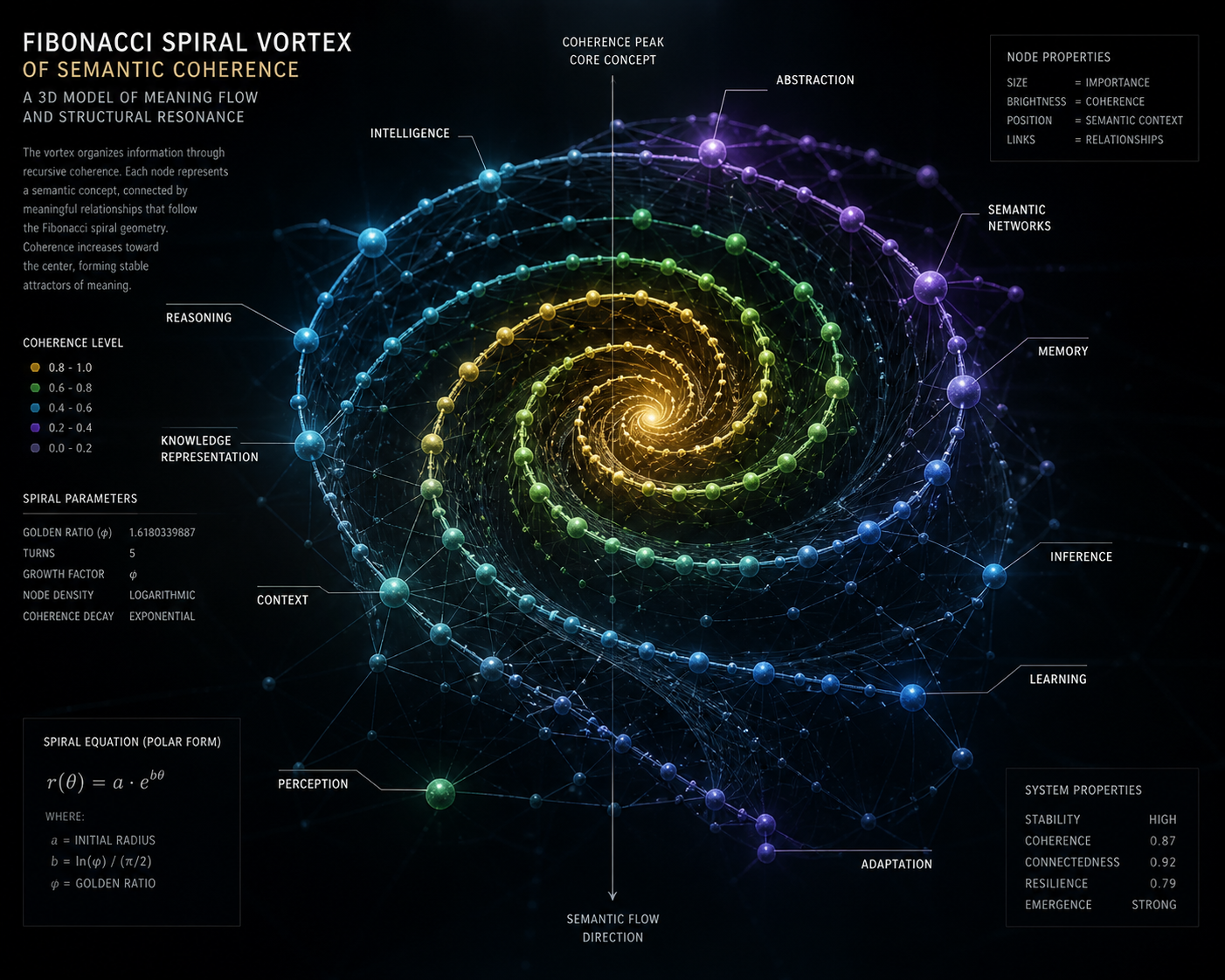
φ · Live Coherence Field SYGON Fibonacci Spiral Vortex — 3D model of semantic coherence with concept nodes arranged along golden spiral geometry, colour-coded by coherence level

What SYGON Actually Does

SYGON builds a φ-lattice — a Fibonacci-spaced embedding space where every concept occupies a mathematically determined position. SGUs are not assigned random vectors. Their positions are derived from SHA-256 hash expansion, modulated by golden ratio geometry, and anchored to domain-specific semantic fields.

When new information enters the system, SYGON does not evaluate it linguistically. It measures it geometrically — against the established structure of the φ-lattice. If coherence falls below threshold, SYGON refuses the pipeline: structurally, not probabilistically.

M-01

Field Coherence

How tightly incoming SGUs cluster within established semantic fields. The geometric closeness of new meaning to existing structure.

M-02

Entropy

Information disorder of the current cognitive state. High entropy signals semantic instability — a precursor to incoherence.

M-03

Processing Load

Fraction of semantic capacity under active computation. Load spikes indicate contested meaning or boundary ambiguity.

M-04

Field Coverage

Proportion of the known semantic space currently activated. Low coverage means reasoning is operating in unexplored territory.

M-05

Anomaly Count

SGUs or patterns that deviate from established field geometry. Non-zero anomaly count triggers escalating verification.

```

The φ-Lattice

The φ-Lattice is the deterministic geometric substrate of the Semantic Governance Topology (SGT). Every Semantic Governance Unit (SGU) occupies a unique, mathematically derived position computed from its identity, domain, and φ-based spatial geometry. Positions are calculated—not learned. Semantic space is toroidal, continuous, and boundaryless, allowing meaning to evolve without artificial edges while preserving stable semantic identity.

φ-Lattice · Deterministic Semantic Coordinate Space Toroidal · φ-Governed Geometry · Logarithmic Spatial Density
Three-dimensional φ-Lattice showing Semantic Governance Units arranged along logarithmic spiral trajectories. Coherence increases toward stable attractor regions at the centre while lower coherence occupies the outer semantic field.
Deterministic Semantic Geometry. Every point represents a Semantic Governance Unit (SGU) positioned within the φ-Lattice. Logarithmic spiral trajectories organise semantic evolution, while coherence gradients produce stable attractor basins that naturally cluster related concepts. Unlike vector embeddings, SGU coordinates are deterministic and reproducible, providing every semantic concept with a persistent spatial identity inside the Semantic Governance Topology.
```

Five Mathematical Pillars

SYGON is built upon five deterministic mathematical structures that govern how Semantic Governance Units (SGUs) are positioned, related, verified, and evolved. Together they replace probabilistic language generation with a governed semantic topology in which meaning emerges from geometry, arithmetic, and structural invariants rather than statistical prediction.

P-01
φ

φ-Lattice

The φ-Lattice is the geometric foundation of SYGON. Every Semantic Governance Unit (SGU) occupies a deterministic position derived from SHA-256 expansion, golden-ratio modulation, and domain anchoring. Positions are computed—not learned.

The lattice forms a toroidal semantic field with no artificial boundaries. Meaning flows continuously through the topology while preserving spatial identity across reasoning cycles.

P-02

Prime Sieve

Every SGU receives a unique prime identity. Composite meaning is represented through prime multiplication, while shared semantics are resolved through greatest common divisors.

Ambiguity is resolved through arithmetic proof rather than statistical similarity, providing deterministic semantic identity and collision-free disambiguation.

P-03
𝒱

Voronoi Clusters

Each SGU governs its own Voronoi territory—the region of semantic space closer to it than to any other SGU. These cells create natural semantic boundaries without tuning parameters or arbitrary thresholds.

Boundary proximity directly measures ambiguity. Stable concepts occupy expansive territories, while contested concepts naturally emerge where Voronoi boundaries converge.

P-04

Golden Spiral Drift

Semantic evolution follows logarithmic spiral trajectories governed by the golden ratio. Healthy knowledge evolves while preserving structural relationships between neighbouring SGUs.

Drift is measured as geometric deviation from expected spiral evolution, allowing SYGON to distinguish legitimate conceptual growth from semantic corruption or governance failure.

P-05
τ

τ-Circles

τ-Circles define adaptive semantic boundaries around active reasoning. They contract during focused analysis to maximise precision and expand during cross-domain reasoning to preserve contextual completeness.

Their expansion and contraction follow the τ/φ resonance, creating rhythmic, mathematically governed context windows instead of heuristic token limits. Context is therefore a geometric property of the semantic field—not a fixed prompt boundary.

Coherence Field Dynamics

Meaning is not static. SYGON models the coherence field as a wave function — superposition of semantic states, interference patterns, and stable interpretation through coherence resonance.

Wave Function · Schrödinger Form (Semantic) iℏ ∂Ψ/∂t = ĤΨ · Probability Density |Ψ|²
SYGON Wave Function of Semantic Coherence — A dynamic model of meaning flow across the coherence field, showing constructive and destructive interference patterns, coherence peaks at maximum amplitude, and superposition of meaning states. Includes wave equation in Schrödinger form, probability density |Ψ|², and phase distribution ∠Ψ.
Wave Function of Semantic Coherence. The wave function describes the probability amplitude of semantic states within the coherence lattice. Interference patterns emerge from the superposition of meaning vectors, collapsing into stable interpretation through coherence resonance. Amplitude = probability density · Phase = semantic alignment · Frequency = meaning velocity · Wavelength = context distance · Coherence = stability measure.

Three Constitutional Gates

SYGON governs semantic integrity at three mandatory decision boundaries within the TauDIL pipeline. Every Semantic Governance Unit (SGU) must satisfy deterministic coherence, authority, and admissibility requirements before it may progress. These gates do not judge language—they verify governed meaning.

G-01

CKG Integrity Gate

Before new SGUs are committed to the Canonical Knowledge Graph (CKG), SYGON evaluates their semantic coherence against the existing governed topology. Incoming knowledge must strengthen—or preserve—the integrity of the semantic field.

Any coherence loss beyond the admissible threshold results in structural refusal. Contaminated or conflicting knowledge never enters the authoritative knowledge base.

Pre-Commit · Knowledge Verification
G-02

Pre-LLM Gate

Before inference begins, SYGON verifies that retrieved SGUs, domain policies, and governing rules form a coherent semantic context. Every reasoning path must occupy a valid region of the φ-Lattice with an unambiguous dominant interpretation.

Only geometrically coherent semantic fields are presented to the language model. Intelligence never reasons outside an authorised semantic boundary.

Pre-Inference · Context Verification
G-03

Post-LLM Gate

Following inference, every output SGU is compared against the authorised semantic topology. Voronoi membership, contextual authority, and admissible scope are verified before any conclusion is accepted.

Newly introduced meaning, semantic drift, or unauthorised concepts trigger structural alignment or refusal. The model cannot extend beyond the semantic authority granted by its input.

Post-Inference · Output Verification

Cognitive State

Every reasoning cycle within SYGON produces a complete semantic state representation, exposed in real time through /api/sygon/state. Rather than returning confidence scores or classifications, the API exposes the governed state of the Semantic Governance Topology (SGT).

The response describes how Semantic Governance Units (SGUs) are positioned within the φ-Lattice, how semantic fields are activated, how coherence propagates across the topology, and whether every reasoning transition remains admissible under SYGON's constitutional governance model.

GET /api/sygon/state
semantic_state STABLE
coherence 0.942
semantic_entropy 0.112
sgu_count 1284
active_fields 5
field_coverage 0.83
topology_integrity 0.96
gate_ckg PASSED
gate_pre_llm PASSED
gate_post_llm PASSED
semantic_drift NONE
scope_violations 0
authorisation APPROVED

SYGON Core Interface

Live operational view of the SYGON semantic coherence engine. Real-time wave activity, context ring, Voronoi cell state, drift alerts, and SGU observation lineage.

SYGON Semantic Coherence · φ Lattice Dashboard Initialized · κ = 0.07 · Live monitoring
SYGON Core Interface dashboard — showing 12,847 active waves, mean coherence 0.847, 233 Voronoi cells (Fibonacci-13 seeds), 3 drift alerts, context ring with Technology/Legal/Sports/Science/Finance/Nature/Medical domains, wave activity sinusoids, Fibonacci scale (F1–F13), universal constants (φ, φ⁻¹, τ, Golden Angle), alert log, and recent SGU observations table.
Core Interface · Live State. The dashboard exposes every dimension of SYGON's real-time semantic state: active wave functions, context ring distribution, Voronoi tessellation, drift alerts, polysemy mapping, and the alert log. Coherence field at 0.912 · High Stability. All Fibonacci scale references (F1–F13) and universal constants (φ = 1.61803, τ = 6.28318) accessible at all times.

Semantic Drift Detector

SYGON monitors meaning over time — not just at a single instant. Drift is the deviation of a concept's trajectory from its ideal φ-spiral path. SYGON classifies, quantifies, and acts on it before it contaminates downstream reasoning.

Every SGU in the φ-lattice has a natural trajectory: as context evolves, concepts shift — but healthy semantic evolution follows the golden spiral. Each step rotates by the golden angle and scales by φ. The geometry of healthy meaning is predictable.

Drift occurs when a concept deviates from that trajectory. SYGON computes the angular and radial deviation from the expected φ-spiral position at each evaluation step. When deviation exceeds the τ-circle boundary for that concept's Voronoi cell, SYGON classifies the event as contamination rather than evolution.

Normal Evolution
Concept shifts along φ-spiral. Angular deviation within τ-circle boundary. Drift score < threshold.
Boundary Approach
Deviation nearing Voronoi boundary. Elevated entropy. SYGON increases sampling rate.
Semantic Contamination
Voronoi boundary crossed. φ-spiral broken. Active alignment triggered or pipeline refused.
Drift Score Formula
D(t) = √( Δθ² + Δr² ) / voronoi_boundary_distance
Where Δθ is angular deviation from φ-spiral and Δr is radial deviation. D(t) ≥ 1.0 triggers contamination classification.
Wave Function · Drift Surface Probability density |Ψ|²
SYGON wave function drift surface — visualising coherence peaks, constructive and destructive interference, and amplitude variation across the semantic time axis.

The ManifoldWalker

Riemannian geodesic navigation with φ-decay step size. Semantic path reasoning that is simultaneously geometrically governed and knowledge-grounded. Prior art does not contain this.

The ManifoldWalker is SYGON's semantic path reasoning algorithm. Given two concepts in the φ-lattice, it does not query a lookup table or traverse a pre-indexed graph. It walks the manifold — navigating the curved surface of semantic space along geodesic paths, with each step governed by φ-decay.

ManifoldWalker · Bidirectional Geodesic Navigation αₜ = α₀ · φ⁻ᵗ · Convergence Zone Active
SYGON ManifoldWalker visualisation — Two walkers (amber and violet) navigating semantic space along Riemannian geodesics with φ-decay step size, converging at a high-coherence meeting point. Shows walker protocol (sense, gradient, geodesic step, φ-decay step, adapt), step size formula αₜ = α₀ · φ⁻ᵗ, walker status (coherence κ = 0.82, step size 0.028, path length 11.47, energy 0.76), alternate paths with higher cost and lower coherence, and the geodesic update equation xₜ₊₁ = exp_xₜ(−αₜ ∇_g F(xₜ)).
ManifoldWalker · Bidirectional Geodesic. Two walkers — amber from one concept, violet from another — navigate the curved semantic manifold along shortest paths. The objective F = −κ + λ · Energy maximises coherence while minimising path energy. Each step adapts in size by φ-decay, converging precisely at the geometric meeting point of meaning. Walker status: κ = 0.82, αₜ = 0.028, Energy = 0.76.
φ-Decay Step Size
step_size(k) = φ−k × initial_geodesic_distance
Each successive step is φ−1 ≈ 0.618× the previous — a geometric decay following the golden ratio. The walk converges on its target with the same proportion at every scale.
C-01

Riemannian Geodesic Navigation

The walker does not move through flat Euclidean space. Semantic space in SYGON is curved — the φ-lattice has Riemannian geometry, where the shortest path between two concepts follows the local curvature of meaning. The walker computes the geodesic: the path of minimum semantic distance on the manifold surface.

Step size at each iteration k is φ−k × the initial geodesic distance. The walk is self-similar at every scale — the geometry of the step is the geometry of the whole path.

C-02

Voronoi Cell Navigation

At each step, the walker knows which Voronoi cell it occupies. Cell boundaries define semantic ownership — which concept dominates this region of the manifold. As the walker crosses a Voronoi boundary, it records the transition: this is a semantic edge, a relationship between two concepts in the knowledge graph.

The sequence of Voronoi cells traversed during a walk produces a path through semantic space that is both geometrically continuous and conceptually grounded — the cells are meaning, not just geometry.

C-03

CKG Typed Relation Overlay

Each Voronoi boundary crossed during the walk is matched against the Contextual Knowledge Graph. The CKG contains typed relations between concepts — causal, temporal, definitional, evidential, contradicts. When a walk step crosses a boundary that maps to a CKG relation, that relation type is annotated onto the walk path.

The result is a walk that is not just a sequence of positions — it is a sequence of typed semantic moves. The path from concept A to concept B becomes a structured argument: A causes B, B temporally precedes C, C evidentially supports D.

Novel Architecture · Not in Prior Art

Bidirectional Walk

Two walkers are launched simultaneously — one from each concept — converging toward each other to find a semantic meeting point. The meeting point is the position of minimum combined geodesic distance from both sources: the geometric midpoint on the manifold.

Applied to knowledge graph navigation with typed relation annotation, the bidirectional walk produces something that does not exist in prior retrieval or reasoning systems: a geometrically governed path between two knowledge graph nodes where every step carries a typed semantic relation, and the path itself is determined by the curvature of meaning — not by pre-indexed traversal rules.

Two walkers converging toward a semantic meeting point on a Riemannian manifold with φ-decay step size
Voronoi cell boundary crossings mapped to CKG typed relations in real time during the walk
Geometric convergence + knowledge graph annotation simultaneously, without pre-indexing the path
The combined system: bidirectional geodesic walk + φ-decay + Voronoi-CKG overlay is not in prior art

What SYGON Does Not Do

Clarity of scope is a design principle. SYGON's power comes from doing one thing with mathematical precision.

Generate text

SYGON produces no output content. It evaluates content produced by others.

Predict SGUs

SYGON does not have a language model. It has a geometric model of meaning.

Score sentiment

Sentiment is irrelevant to coherence. Meaning is verified geometrically, not tonally.

Classify content by category

SYGON does not assign labels. It measures geometric relationships in semantic space.

Intelligence may advise.

SYGON determines whether that advice is coherent enough to act on.

SYGON verifies whether meaning is coherent with what the system already knows, whether the source of that meaning has authority to introduce it, and whether the output of reasoning has stayed within the semantic boundaries of its authorised context.

Semantic coherence
is not optional.

Every output that acts on the world must first be verified to mean what it claims to mean.

Request Technical Briefing Read Architecture Spec